
What Canada benefit stacking rules mean for low-income earners

Imagine sitting at your kitchen table in Halifax or Winnipeg, surrounded by paperwork from the CRA, Service Canada, and your provincial housing office.
You’ve just discovered that a modest raise at your part-time job might result in a net loss of income because it triggered a simultaneous reduction in three different subsidies.
This “clawback” effect is a documented reality for many navigating Canada benefit stacking rules in 2026.
For those attempting to improve their financial standing, the system can sometimes feel like a ladder that slides backward just as one gains a footing.
The complexity of Canada’s social safety net has reached a point where understanding the interaction between programs is essential for household budgeting.
We are operating within a fragmented framework where federal initiatives and provincial programs do not always align, leaving recipients to navigate the overlap.
This phenomenon, often referred to by economists as the “welfare wall,” occurs when the transition from social assistance to increased employment income results in a stagnant or diminishing net financial gain.
Navigating the Benefit Maze
- The Interaction Effect: How federal credits like the CCB interact with provincial rental assistance and social programs.
- Income Thresholds: Identifying the specific income ranges where earning additional dollars may lead to significant benefit reductions.
- Clawback Calculations: A breakdown of how different supports scale back as household income increases.
- Administrative Timing: Why the timing of tax filings and income reporting impacts benefit eligibility throughout the year.
Why do Canada benefit stacking rules impact low-income earners?
The primary challenge lies in the lack of harmonization between levels of government.
When the federal government designs the Canada Child Benefit (CCB) or the Canada Workers Benefit (CWB), they establish specific income thresholds.
Concurrently, provinces like Ontario or British Columbia set their own limits for housing, childcare, or pharmacare. The core issue is often the “stacking” of these policies.
When multiple programs begin their phase-out period at a similar income level, a worker may face an effective marginal tax rate that exceeds 80%.
This structure can create a disincentive for upward mobility.
If a worker earns an additional $1,000 but consequently loses $400 in rent subsidies, $300 in child tax credits, and $150 in other rebates, the net gain is only $150 despite the extra hours worked.
This lack of staggering in program exit points can make it mathematically difficult for low-wage earners to transition into higher income brackets.
++ What Canada benefit stacking rules mean for low-income earners
How the 2026 “Benefit Clawback” affects monthly budgets
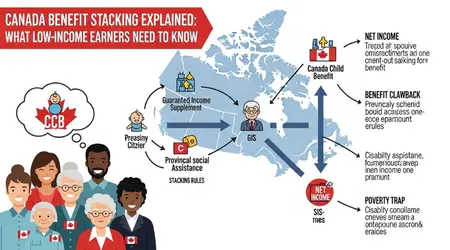
In 2026, social support has shifted toward more targeted delivery, which necessitates stricter income testing. For a recipient, the critical metric is “Adjusted Family Net Income” (AFNI).
This figure determines access to almost all income-tested programs.
If a family’s AFNI increases due to a seasonal contract or a bonus, the financial impact is often delayed, appearing months later during the annual benefit redetermination period.
It is helpful to view benefits as a component of “total compensation” to understand the net impact of working more hours.
For instance, while the Canada Workers Benefit is intended to supplement low wages, some provincial disability or housing programs may count the CWB as income, potentially leading to a dollar-for-dollar reduction in provincial support.
In such cases, the recipient may be working more without increasing their actual disposable income.
Case Study: The Interaction of Benefits in Ontario
Consider the scenario of Maria, a single mother in London, Ontario, with two children. She currently earns $34,000 a year.
- Current Status: Maria receives the maximum CCB, the Ontario Trillium Benefit, and resides in a subsidized housing unit where rent is set at 30% of her income.
- The Change: Maria is offered a lead hand position with a salary of $42,000 an $8,000 increase.
- The Financial Outcome:
- Taxes: Income tax increases by approximately $1,800.
- Housing: Her rent increases by $2,400 annually because it is tied to her gross income.
- CCB: Her Canada Child Benefit is reduced by roughly $1,100 as her income moves past the threshold.
- CWB: She loses the “base” portion of the Canada Workers Benefit, valued at about $1,400.
- The Net Result: Out of the $8,000 salary increase, Maria’s net household gain is approximately $1,300.
After accounting for increased employment costs such as transit or childcare the actual improvement in her quality of life may be negligible.
This case demonstrates how Canada benefit stacking rules can penalize career advancement if phase-out rates are not coordinated.
Also read: How Auto-Enrollment of Federal Benefits (2026 Onwards) Will Help Low-Income Canadians
Evaluating the Current Benefit Structure
While the system is complex, it provides essential support.
The challenge for 2026 is the creation of a “middle-income” gap where households earn too much to qualify for assistance but not enough to meet the rising cost of living independently.
| Program Feature | Potential Benefit (Utility) | Stacking Risk (Clawback) |
| Canada Child Benefit (CCB) | Significant impact on reducing child poverty; non-taxable. | Notable phase-outs for families earning between $35k and $75k. |
| Canada Workers Benefit (CWB) | Provides quarterly cash supplements for low-wage workers. | May be offset by provincial programs if counted as “social assistance.” |
| GST/HST Credit | Reliable payments for basic household needs. | Relatively low income cut-off; sensitive to small income changes. |
| Provincial Housing Subsidy | Maintains affordability in high-cost urban centers. | Often features aggressive clawbacks (up to 30% of earned income). |
| National Dental/Pharmacare | Reduces out-of-pocket costs for essential health services. | May feature “cliffs” rather than gradual phase-outs based on income. |
Why “Benefit Awareness” is necessary
Data suggests that many Canadians do not anticipate how income changes will affect future benefits.
Because the CRA uses the previous year’s tax return to set benefits for the following July-to-June cycle, there is a significant time lag.
An increase in income during 2025 will cause a drop in benefits in late 2026, which can create a cash-flow crisis if the household’s circumstances have changed since then.
Using a benefit calculator regularly is a practical way to manage these changes.
Predicting a reduction allows households to set aside a portion of their current earnings to cover the eventual “benefit gap.”
Proactive planning is often the only way to mitigate the impact when Canada benefit stacking rules eventually adjust a family’s monthly payments.
Programs and “Income-Blind” Benefits
Not all supports are income-tested in the same manner.
Some programs, like the Canada Carbon Rebate (formerly the Climate Action Incentive), are generally not tied to income levels; residents of a province usually receive the same amount.
These supports are considered “stack-friendly” because they do not penalize increased employment.
However, the most significant risk in 2026 involves “non-cash” benefits, such as subsidized dental care or $10-a-day daycare.
Earning slightly over a threshold can result in a “hard cliff,” where a small salary increase causes a complete loss of a high-value subsidy.
For many families, losing a childcare spot is a far greater financial blow than losing a monthly cash tax credit.
Navigating the “Welfare Wall” Effectively
Managing the transition over the “welfare wall” requires strategic financial oversight. When considering a promotion or extra shifts, it is necessary to calculate the net after-tax and after-benefit income.
In some specific cases, the financial gain of working more may be so low that the time might be more effectively used for education or family until a significantly higher salary bracket is achievable.
Economists use the term “Effective Marginal Tax Rate” (EMTR) to describe this.
While high earners may face a top tax rate of 53%, a low-income single parent in 2026 can face an EMTR of 75% or higher when benefit losses are included.
This means the system can be effectively more regressive for those at the lower end of the income scale.
Strategies for Long-Term Stability
Navigating Canada benefit stacking rules requires treating household finances like a managed portfolio.
The goal is to identify the “sweet spot” where total income including both wages and subsidies is maximized with the least amount of clawback friction.
Maintaining up-to-date tax filings and communicating with provincial social offices are essential steps. Asking specific “what-if” questions regarding income changes can help prevent unexpected debt.
While the system remains complex, staying informed is the most effective way to avoid the pitfalls of the welfare wall and ensure that work actually results in a higher standard of living.
Frequently Asked Questions
Does the CWB (Canada Workers Benefit) decrease if I receive the CCB?
No. The CCB is not considered taxable income and does not directly reduce your CWB. However, both are calculated based on your net family income.
If your employment income rises, both programs may begin their respective clawbacks at the same time.
How do I know if a raise is financially worth it?
Calculate your “Real Disposable Income.” Take your new gross salary, subtract taxes, and then subtract the value of any lost subsidies (rent, childcare, tax credits).
If the final number is very close to your current net, the raise may not provide a significant financial benefit.
Why did my housing subsidy decrease after I received the Carbon Rebate?
In most provinces, the Canada Carbon Rebate is exempt and should not be counted as income for social housing calculations. If this occurs, it may be a clerical error.
You should verify with your housing provider that exempt federal rebates are being excluded from your income assessment.
Is there an income limit where all benefits disappear at once?
There is no single “cliff” for all programs, but the range between $35,000 and $45,000 is often the most volatile.
This is where multiple provincial and federal phase-outs frequently overlap, leading to the highest effective marginal tax rates.
How does the Canadian Dental Care Plan (CDCP) impact my budget in 2026?
The plan has a family net income limit of $90,000. However, those earning between $70,000 and $90,000 are required to pay a co-payment (up to 40%).
Crossing the $70,000 threshold can introduce new out-of-pocket costs that should be factored into any salary negotiations.