
Why secondary school pathway Canada gains student advantage

The dream of a Canadian education often starts with a glossy university brochure featuring the CN Tower or the Rocky Mountains.
But if you’re sitting at your kitchen table, looking at the skyrocketing costs of international tuition and the increasingly competitive permanent residency (PR) landscape of 2026, those brochures can feel like a fantasy.
For years, I’ve seen families pour their life savings into a master’s degree, hoping it’s the golden ticket, only to realize they’ve jumped into the deep end without a life jacket.
What many are finally waking up to is that the real “cheat code” to the Great White North isn’t at the post-graduate level it starts much earlier.
Entering the system via a secondary school pathway Canada is no longer just an “elite” option for the wealthy; it has become a strategic financial and immigration move.
It’s about getting your foot in the door while the door is still wide open, rather than trying to squeeze through the narrow gap of the Express Entry draws later in life.
Summary of Insights
- The Early Start Advantage: How high school credits simplify university admissions.
- The Financial Calculus: Why paying for high school can save you thousands in the long run.
- Cultural Integration: Solving the “Soft Skills” gap before the job market.
- The 2026 Policy Landscape: Why IRCC favors Canadian-grown graduates.
- Comparative Analysis: Secondary vs. Post-Secondary pathways.
- FAQ: Real answers for concerned parents.
Why is the secondary school pathway Canada becoming the preferred route in 2026?
In my fifteen years covering the intersection of Canadian policy and your wallet, I’ve noticed a shift. The federal government has become increasingly “picky.”
In 2026, having a degree isn’t enough; they want people who are already “Canadianized.” When a student enters a Canadian high school, they aren’t just learning algebra; they are building a verifiable history of integration.
What many forget to observe is the sheer bureaucratic friction this removes.
If you graduate from a high school in British Columbia or Ontario, you aren’t just another international applicant when you apply to the University of Toronto or McGill.
You are an “internal” candidate with an OSSD (Ontario Secondary School Diploma) or Dogwood Diploma.
You’ve bypassed the high-stress English language proficiency tests like IELTS or TOEFL because you’ve already proven your mettle in a local classroom.
This isn’t just a convenience it’s a massive psychological relief for the student and a significant hedge against admission rejection.
++ How study permit fraud cases Canada raise policy concerns
The Hidden ROI: Is it actually cheaper to start earlier?
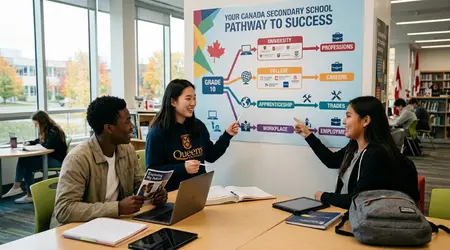
At first glance, paying for two or three years of private or public high school tuition seems like a heavy lift. However, let’s look at the “hidden” return on investment.
On my analysis, students who complete a secondary school pathway Canada have much higher success rates in securing entrance scholarships for university.
These awards, often ranging from $2,000 to $20,000, are frequently tied to Canadian curriculum performance.
Furthermore, there is the “time is money” factor. International students coming from abroad often lose a year or more doing “bridge” programs or language upgrading because their home country’s curriculum doesn’t align with Canadian standards.
By starting in Grade 10 or 11, you eliminate that gap year. You hit the ground running, graduate university sooner, and enter the workforce at a younger age.
In the world of compound interest and career earnings, that two-year head start is worth more than the initial tuition cost.
Case Study: The “Two-Path” Reality for a Family in 2026
Imagine a family, the Patels. They have two children, Aarav and Meera.
Aarav stays in his home country, finishes high school with top marks, and applies to a Canadian university in 2026.
He struggles with the conversion of his grades, spends $500 on English testing, and eventually gets in but receives no scholarships.
He arrives in Canada at age 18, experiencing a massive “culture shock” that affects his first-year GPA the year that arguably matters most for internships.
Meera, on the other hand, enters an Ontario high school for Grade 11.
By the time she reaches university, she has a network of local friends, understands the “soft skills” of Canadian networking, and has mastered the art of the Canadian essay format. She secures a $5,000 “In-Province” entrance scholarship.
My recommendation for you is to look at Meera’s path.
While the Patels paid more upfront for Meera’s high school, her path to a high-paying co-op job and eventual PR is significantly smoother. She isn’t just a guest in the country; she’s a product of it.
Also read: Book Bans in Alberta Schools: The Debate Over Censorship, Curriculum, and Student Rights
How does this pathway impact Permanent Residency (PR) in 2026?
The IRCC (Immigration, Refugees and Citizenship Canada) has moved toward a “human capital” model that deeply rewards Canadian experience.
While a high school diploma itself doesn’t grant more points in the Comprehensive Ranking System (CRS) than a foreign one, the ancillary benefits are massive.
A student on a secondary school pathway Canada develops better language fluency (climbing to CLB 9 or 10 easily), gains local part-time work experience that is actually recognized by employers, and builds a “Canadian network” that is vital for the “Job Offer” points in many Provincial Nominee Programs (PNPs).
In 2026, where the “points” required for PR stay stubbornly high, these marginal gains are the difference between staying in Canada or being forced to leave after your Post-Graduation Work Permit (PGWP) expires.
Comparison: Secondary Pathway vs. Direct University Entry
| Feature | Secondary School Pathway | Direct University Entry |
| Language Requirements | Integrated learning (No IELTS usually) | High-stakes testing (IELTS/TOEFL) |
| Adaptation Period | Done during lower-stakes high school years | Happens during high-stakes university years |
| University Admissions | Higher (Canadian diploma status) | Competitive (International pool) |
| Scholarship Access | High (Domestic/Local awards) | Limited (International specific only) |
| Social Integration | Deep (Local peer groups) | Often limited to international student circles |
The “Soft Skills” Gap: What textbooks don’t teach you
If there’s one thing I’ve learned from interviewing Canadian hiring managers, it’s that they value “cultural fit” almost as much as technical skill.
The “Canadian way” involves a specific type of collaboration, a certain polite directness, and a heavy emphasis on volunteerism and community.
Students who arrive for university often spend four years in a “bubble,” hanging out with people from their own country. But a teenager in a Canadian high school?
They’re in the thick of it. They join the basketball team, participate in the Terry Fox Run, and learn the local slang (yes, they’ll be saying “double-double” and “loonie” in no time).
By the time they interview for their first internship, they sound and act like a local. It’s an intangible asset that you simply cannot put a price on.
Read more: Quebec Builds the ‘House of Knowledge’: A University by and for Indigenous Peoples Is Coming by 2027
Final Thoughts for Parents and Students
Navigating the Canadian immigration and education maze in 2026 requires a bit of “hockey sense” you don’t skate to where the puck is; you skate to where it’s going to be.
The puck is moving toward a system that favors those with deep roots. If you have the means, starting early isn’t just an educational choice; it’s a strategic life move.
It buys your child time, confidence, and a level of integration that no university degree can provide in isolation. My advice?
Don’t wait for the university acceptance letter to start your Canadian life. Start it in the classroom where the foundations are actually built.
It might just be the smartest financial and personal decision your family ever makes.
Common Questions about the Secondary School Pathway Canada
Is there a minimum age to start the secondary pathway?
Most school boards and private institutions accept students starting at Grade 9 (approx. 14 years old), but the “sweet spot” for many is Grade 10 or 11.
This allows enough time to earn the 30 credits required for an Ontario Secondary School Diploma (OSSD) without feeling rushed.
Can international students attend public high schools?
Yes, absolutely. Most Canadian public school boards have robust international student programs.
You will still pay tuition (usually between $14,000 and $16,000 CAD per year), which is significantly lower than many private boarding schools.
It’s a fantastic way to get a high-quality education while being immersed in a “real” Canadian neighborhood.
What happens if my child doesn’t live with me?
Canada has a very organized “Homestay” system. Students live with vetted Canadian families who provide meals and a room.
This is often the best part of the secondary school pathway Canada because it forces the student to speak English or French at home and provides an immediate emotional support system.
Does the secondary pathway guarantee a Study Permit?
No path is “guaranteed,” but IRCC generally views high school applications favorably because they demonstrate a long-term commitment to the Canadian system.
As long as the financial proof is solid and the “intent to reside” is clear, success rates remain high.