
Canada defense shift signals new military strategy 2026 direction

The current fiscal year has brought a significant shift in how Canada approaches its national security and continental obligations.
For many Canadian households, the connection between global defense spending and local economic conditions can seem abstract.
However, the recent scale of federal investment indicates a fundamental pivot in national priorities.
The Canada defense shift signals new military strategy that moves beyond routine equipment replacement toward a long-term structural overhaul of the nation’s armed forces and northern infrastructure.
For years, the discourse around Canadian defense often focused on the difficulty of maintaining aging assets. Today, that conversation has changed.
With the federal government accelerating its commitment to meet international obligations, the 2026 budget marks a point where geopolitical strategy begins to intersect directly with domestic industrial policy and regional economies.
Quick Guide to the Defense Modernization
To understand the scope of these changes, it is helpful to look at the primary targets and technical investments currently underway:
- Spending Targets: Achieving 2% of GDP in 2026, totaling approximately $63 billion annually.
- Strategic Focus: Strengthening Arctic sovereignty and enhancing independent operational capacity.
- Economic Projections: An estimated creation of 125,000 new jobs, balanced against long-term fiscal considerations.
- Technical Acquisitions: Procurement of 12 new conventional submarines, F-35 fighter jets, and “Arctic Over-the-Horizon” radar systems.
Contextualizing the Surge in Defense Spending
Historically, Canada’s defense policy has relied heavily on integrated continental protection shared with the United States.
However, the Canada defense shift signals new military strategy that prioritizes increased self-sufficiency.
This transition is driven by a recognition of changing global dynamics and the increasing accessibility of the Arctic region.
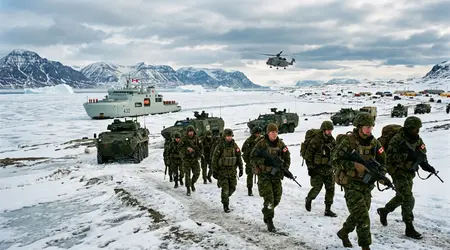
As northern ice continues to thin, the Arctic is no longer a natural barrier but a corridor for international activity, requiring a permanent and robust Canadian presence.
The government is currently allocating $35 billion specifically toward Northern infrastructure. These projects are characterized as “dual-use” facilities.
This means that while they serve military operational needs such as refueling and logistics they also provide essential services to local Indigenous communities and remote territories.
The objective is to utilize defense spending as a catalyst for northern economic development, providing ports and airstrips that facilitate both security and civilian trade.
++ USMCA renegotiation delays fuel Canada trade uncertainty 2026
Economic Implications: Industrial Growth and Fiscal Responsibility
From an economic perspective, large-scale defense spending acts as a significant industrial policy.
The Defence Industrial Strategy (DIS) stipulates that 70% of procurement contracts should remain within Canada. This shift aims to transition from purchasing foreign-made equipment to fostering a domestic “defense ecosystem.”
For sectors such as advanced manufacturing in Ontario, aerospace in Quebec, and shipbuilding in the Maritimes, this policy represents a substantial influx of capital.
Projections suggest that this could support up to 340,000 jobs over the next decade.
Nevertheless, from a public finance standpoint, the allocation of $63 billion annually with projections potentially rising in the coming decade requires careful management.
While the government intends to fund these initiatives by optimizing existing real estate and operational efficiencies, the long-term impact on the federal deficit remains a point of observation for fiscal analysts.
Comparative Analysis: Evolution of Canadian Defense Strategy
| Feature | Previous Strategy | New 2026 Strategy Direction |
| NATO Spending | Approximately 1.3% of GDP | 2.0% (Achieved March 2026) |
| Partnership Reliance | High reliance on NORAD/U.S. | Focus on “Self-Sustaining” defense |
| Arctic Presence | Seasonal or occasional patrols | Year-round “Hub and Node” network |
| Procurement | Fragmented, often foreign-sourced | Streamlined via New Defense Agency |
| Economic Goal | Cost-management focus | Job creation and industrial growth |
Impact on Regional Economies and Daily Life
The practical effects of the Canada defense shift signals new military strategy vary significantly by region.
In coastal cities like Halifax, the modernization of dockyards and the construction of new River-class destroyers provide long-term subcontracting opportunities for local machine shops and engineering firms.
For professionals in these sectors, the defense shift often translates into improved job security and increased demand for specialized labor.
Conversely, the broader population may feel the impact through shifts in federal spending priorities.
To maintain a $63 billion defense budget, the government must manage “non-essential” operational spending across other departments.
This reallocation of resources can influence the delivery of social programs or the wait times for federal services.
The current era represents a balancing act between investing in national security and maintaining the standards of social security that Canadians expect.
The Arctic Pivot and Infrastructure Development
A central component of the 2026 direction is the establishment of “Northern Operational Support Hubs.”
Located in areas such as Whitehorse, Resolute, and Rankin Inlet, these hubs are designed for more than just military exercises.
They serve as the foundation for the Mackenzie Valley Highway and other critical transport arteries.
By classifying these projects as strategic for defense, the government can often expedite infrastructure that would otherwise face prolonged bureaucratic delays.
For the approximately 140,000 residents of the North, this “dual-use” approach can lead to improved telecommunications, more reliable supply chains, and potentially lower costs for essential goods.
However, it also introduces a more visible military presence into previously quiet, remote regions.
Evaluating the 2026 Military Direction
Potential Benefits (Pros):
- Sovereignty: Enhanced capability to monitor and patrol Canadian waters and airspace independently.
- Employment: Growth in high-tech and manufacturing sectors, particularly in specialized industrial hubs.
- Northern Development: Critical infrastructure improvements for Indigenous and remote communities.
- Technological Advancement: Significant investment in cyber-defense and advanced radar systems.
Potential Challenges (Cons):
- Fiscal Pressure: Large annual outlays require consistent economic growth to avoid tax increases or service reductions.
- Diplomatic Complexity: Balancing domestic procurement goals with traditional international trade relationships.
- Logistics and Recruitment: The challenge of staffing and maintaining complex new fleets of submarines and aircraft during a period of labor shortages.
The Fiscal Reality of a Sovereignty Shift
The Canada defense shift signals new military strategy that acknowledges the complexities of a modern global environment.
For the Canadian public, the focus remains on ensuring that these multi-billion-dollar investments are managed with transparency and efficiency.
Historically, large-scale procurement has faced challenges regarding timelines and budget overruns.
The “Carney Shift” represents a move toward a more autonomous Canada, capable of protecting its interests in the Arctic and contributing more equitably to international alliances.
While the economic benefits to the manufacturing and tech sectors are evident, the long-term sustainability of this spending will depend on the government’s ability to balance these new obligations with the everyday financial needs of Canadian citizens.
Frequently Asked Questions (FAQ)
Will personal income taxes increase to pay for this defense shift?
Currently, the federal government is focused on reallocating existing budgets and utilizing projected economic growth to fund these commitments.
However, if spending targets continue to rise toward 2035, the government may need to explore new revenue streams or further prioritize spending cuts in other departments.
Why is there a focus on submarines and jets over other domestic issues?
The government’s position is that national security and the protection of trade routes are foundational to the economy.
By securing the Arctic and maritime borders, Canada ensures the stability required to fund social programs.
Furthermore, “dual-use” spending often overlaps with civilian needs, such as Northern housing and transportation.
Which provinces will see the most economic activity from these contracts?
Ontario and Quebec are primary hubs for aerospace and technology contracts, while the Maritimes lead in shipbuilding.
The Northern territories will likely experience a significant increase in construction and infrastructure development related to the new support hubs.
What is the purpose of the “Arctic Over-the-Horizon Radar”?
This $6.5 billion project, developed in partnership with Australia, uses advanced technology to monitor airspace beyond the curvature of the earth.
It acts as an early warning system, allowing Canada to identify and respond to unauthorized entries into northern airspace much earlier than current systems allow.
Is this new strategy a permanent change in Canadian policy?
Because procurement for assets like submarines and fighter jets involves multi-decade contracts and maintenance agreements, these decisions represent a generational commitment.
The Canada defense shift signals new military strategy that will likely define the nation’s fiscal and defense posture for the next 30 to 40 years.