
Why Canada university funding cuts trigger campus protests

The experience of dropping a child off at a campus residence has shifted significantly for many Canadian families.
Amid concerns over the escalating cost of meal plans, many parents and students now navigate universities experiencing visible administrative and social upheaval.
Across various campuses, student walkouts, rallies, and demonstrations on central quads have taken the place of typical mid-semester routines.
For a growing portion of the population, these developments represent a new reality within the post-secondary sector.
The underlying drivers of these campus disruptions involve a combination of fiscal tightening and recent adjustments to federal policy.
As provincial governments modify operational funding models and restructure student financial assistance, post-secondary institutions face difficult budgetary decisions.
This wave of campus unrest across the country has prompted discussions regarding why Canada university funding cuts trigger immediate institutional and student reactions.
Industry data suggests the current friction exists at the intersection of student debt levels, rising tuition fees, and a post-secondary funding framework facing structural constraints.
Quick Overview: What You Need to Know
- The Problem: Decades of flat provincial operational grants, combined with new federal limits on international student visas, have created structural budget deficits for multiple Canadian universities.
- The Trigger: To balance institutional books, certain provinces are restructuring financial aid models shifting specific allocations from grants to loans and allowing domestic tuition freezes to thaw, which alters the financial obligations of domestic households.
- The Impact: Registered students frequently report unexpected debt projections, reduced course selections, larger average class sizes, and the scale-back of certain non-academic campus services, leading to organized student advocacy.
Why Are Post-Secondary Budgets Falling Short Across the Country?
To understand why Canada university funding cuts trigger student demonstrations, it is necessary to examine the structural mechanics of Canadian higher education finance.
Over the past decade, provincial operating grants per student have largely remained stagnant or declined when adjusted for inflation.
To maintain balanced operational budgets, many public universities increasingly relied on international student tuition fees, which are not subject to domestic fee caps and are often significantly higher than domestic rates.
Recent changes in federal immigration policy placed a strict cap on international study permits, causing a sudden reduction in projected institutional revenue.
This shift highlighted the vulnerability of current university funding models.
In British Columbia and other jurisdictions, multiple institutions are forecasting operational deficits, resulting in program reviews and the suspension of specific course options.
As the revenue generated from international enrollments experienced limits, the financial pressure began to impact domestic frameworks, generating friction within the broader student body.
++ How Ontario college layoffs 2026 reshape higher education
How Do Funding Restructurings Affect Average Canadian Households?
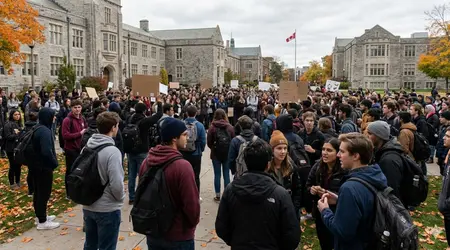
Public analysis sometimes categorizes campus demonstrations solely as ideological movements. However, financial data indicates these events are frequently tied directly to practical household economics.
When a provincial administration announces adjustments to post-secondary funding allocations, the downstream operational changes can influence individual family budgets.
A primary example is the recent structural alteration to the Ontario Student Assistance Program (OSAP).
Although provincial authorities introduced a multi-billion-dollar framework intended to support specific high-demand employment sectors, the internal composition of student aid experienced changes.
Non-repayable student grants, which previously covered a substantial portion of educational costs for lower-income applicants, were capped.
Consequently, a larger proportion of the distributed aid was converted into repayable loans.
For a student relying on public assistance, this adjustment translates into a higher projected debt load upon graduation.
This transition from direct public investment to increased personal liability explains why Canada university funding cuts trigger organized campus pushback.
The resulting student initiatives often represent direct advocacy regarding long-term personal financial stability and economic vulnerability.
A Hypothetical Look at a Family in Ontario
Consider the scenario of a household based in London, Ontario, with two children. The eldest is a third-year biology student, while the youngest plans to enter university the following autumn.
Under the previous financial aid framework, the elder child qualified for a combined package of grants and loans, keeping their estimated graduation debt within a predictable range.
Following the implementation of recent policy changes, the younger sibling faces a different financial structure.
The maximum non-repayable grant portion of their provincial aid allocation is lower, meaning the majority of their funding package is issued as a loan that requires repayment.
Additionally, as multi-year domestic tuition freezes gradually conclude to allow incremental annual adjustments of up to two percent, families may need to reallocate existing funds to cover core institutional fees.
This scenario leaves households facing complex financial choices.
Families may evaluate options such as utilizing private credit facilities, adjusting long-term personal savings plans, or having the student accept a larger total loan volume prior to entering the full-time labor market.
When these individual financial adjustments occur across a broad demographic, student unions frequently respond by organizing campus walkouts and information campaigns.
Balancing the Ledger: Pros and Cons of Fiscal Restructuring
Government representatives frequently argue that structural funding reforms are necessary to maintain sustainable provincial fiscal balances.
Conversely, student organizations maintain that post-secondary education functions as a critical public good.
The table below details the competing policy priorities and objectives driving the current national debate:
| Government / Institutional Objective | Impact on the Student Body & Families |
| Fiscal Sustainability: Aims to limit growing provincial deficits and control taxpayer-funded institutional expenditures. | Increased Debt Burdens: Converts portions of non-repayable grants into loans, increasing overall debt obligations at graduation. |
| Targeted Funding: Redirects available public capital toward sectors experiencing labor shortages, such as healthcare and skilled trades. | Program Reductions: Can lead to the reduction, consolidation, or suspension of humanities, arts, and specialized research streams. |
| Tuition Flexibilities: Allowing controlled tuition adjustments assists universities in addressing general inflationary cost increases. | Higher Cost of Living: Introduces additional financial obligations for families navigating broader inflationary pressures. |
What Changes Are Students Demanding From Their Leaders?
The current demonstrations across Canadian post-secondary institutions generally focus on specific policy objectives.
Student coalitions and campus organizations have outlined distinct legislative and administrative demands aimed at altering contemporary funding trajectories.
First, student unions are requesting a restoration of previous non-repayable provincial grant structures.
Their policy position states that substituting grants with repayable loans disproportionately impacts low-income, mature, and marginalized student demographics, potentially creating barriers to baseline post-secondary access.
Institutional access remains a central focal point of this discussion; historical enrollment data shows that when predictable grant frameworks are reduced, registration rates among lower-income brackets can experience downward pressure.
Second, student groups are advocating for the preservation of broad program diversity.
When institutional funding experiences constraints, universities often prioritize programs tied to corporate sponsorship or high-enrollment STEM fields, sometimes reducing resource allocations for the humanities and liberal arts.
Organized student groups are requesting that provinces increase core operational grants to ensure institutions can maintain diverse faculty structures and avoid compromising undergraduate instructional quality.
Frequently Asked Questions
Why did the government change the balance between grants and loans?
Provincial authorities indicate that the escalating total expenditure required to maintain previous financial aid models is unsustainable over the long term.
By placing caps on non-repayable grants and increasing the proportion of repayable loans, governments aim to manage direct public spending while maintaining general financial credit availability for qualifying applicants.
How do international student caps affect domestic tuition?
When international student registration declines due to modified federal immigration caps, universities experience a reduction in unregulated tuition revenue.
To address the resulting institutional deficits, post-secondary administrations may request adjustments to domestic tuition caps or implement cost-reduction measures affecting campus services, which directly influences the domestic student experience.
What can parents do to mitigate these sudden financial changes?
Financial professionals suggest reviewing Registered Education Savings Plans (RESPs) early and evaluating current financial aid eligibility criteria within your specific province.
Because modern aid packages increasingly utilize loans rather than non-repayable grants, identifying institutional scholarships, internal work-study options, and regional bursaries well in advance of the academic year can assist in managing educational costs.