
Why study permit refusals Canada are rising in 2026

The intersections of federal policy, provincial budgets, and the bank accounts of ordinary individuals in Canada have become a central focus for families, college administrators, and international applicants.
A frequent question among applicants is why formal submissions are turned down despite meeting standard requirements. The regulatory landscape for international education has shifted significantly.
Educational stakeholders are observing changing enrollment patterns, and statistics indicate that study permit refusals Canada are rising as part of updated federal immigration frameworks and structural adjustments.
For applicant households, this transition demands careful financial planning. Applying to a Canadian institution involves non-refundable application fees, international courier costs, and foreign exchange transactions.
When an application is rejected, tuition funds can remain with institutional administrative departments for extended periods while families wait for the refund process to conclude.
What to Expect From This Article
- The Structural Shift: How the 2026 cap of 155,000 new arrivals affects the national admissions allocation process.
- The Financial Framework: How the updated living cost requirement of CA$22,895 influences the assessment of applications.
- The Bureaucratic Process: How the Provincial Attestation Letter (PAL) system creates distinct regional administrative variations.
- Application Management: Informational insights on structuring documentation to align with current regulatory expectations.
Why Is Immigration Canada Rejecting More Student Visas?
To understand the context behind why study permit refusals Canada are rising, it is necessary to examine the operational mechanics of the international student program.
Historically, post-secondary institutions, particularly Ontario colleges, relied heavily on international tuition revenue to support operational budgets. Recent policy updates have altered this model.
The federal government has implemented a national cap, limiting new study permit arrivals to 155,000 for the year.
Following this reduction in allowable incoming student volumes compared to historical peaks, evaluation criteria have adapted.
Immigration, Refugees and Citizenship Canada (IRCC) officers review applications strictly against established compliance standards to remain within the designated national allocation limits.
The evaluation of an applicant’s temporary intent remains a critical component of the review process.
Data indicates that the immigration department applies Section 216(1)(b) of the Immigration and Refugee Protection Regulations which stipulates that an applicant must intend to leave Canada at the end of their authorized stay as a baseline standard.
Even with established post-graduation work pathways, applicants generally must demonstrate clear economic and social ties to their home countries to satisfy this regulatory requirement.
++ Why secondary school pathway Canada gains student advantage
How Does the New Proof of Funds Rule Affect Approvals?
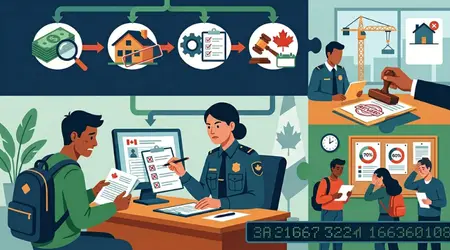
The financial criteria serve as a primary benchmark for evaluation, contributing to the trend where study permit refusals Canada are rising.
For over a decade, applicants were required to demonstrate CA$10,000 in available funds for living expenses.
The government updated this requirement, raising the minimum financial threshold to CA$22,895 for a single applicant, which must be demonstrated in addition to the first year of tuition fees.
When reviewing financial documentation, applicants should note that IRCC guidelines place emphasis on the stability and history of the banking records.
Unexplained lump-sum deposits made immediately prior to the submission of an application frequently lead to closer scrutiny.
Assessing officers typically look for a transparent, documented history of the funds to verify that the capital is fully accessible to the student for the duration of their studies.
This updated threshold changes the baseline financial commitment required from applicants.
An undergraduate program at a Canadian university generally requires demonstrating access to approximately CA$50,000 to CA$60,000 for the initial year, combining tuition and living costs.
If bank records do not clearly verify the source and stability of these funds over a standard six-month period, applications may be refused based on a projected inability to maintain self-sufficiency while residing in the country.
A Tale of Two Pathways: A Comparative Review
The practical impact of these updated regulations depends substantially on the specific level of study and the type of program an applicant chooses to pursue.
The current framework distinguishes between undergraduate or diploma streams and advanced graduate studies.
| Component | Undergraduates & College Diplomas | Master’s & PhD Programs (Public DLIs) |
| National Cap Status | Subject to the strict 155,000 limit | Completely exempt from the cap |
| Provincial Attestation (PAL) | Mandated; must compete for a quota spot | No PAL or TAL required |
| Spousal Work Eligibility | Partners are ineligible for open work permits | Spouses remain eligible for open work permits |
| Refusal Risk Profile | Subject to high scrutiny regarding intent | Subject to standard institutional processing |
Case Analysis: The College Enrollment Scenario
To understand how these policies operate in practice, consider the scenario of an applicant seeking entry into a hospitality diploma program at a public college in southwestern Ontario.
A family might liquidate assets, such as a plot of land, to accumulate CA$45,000 in available capital. They secure an institutional acceptance letter and obtain an Ontario Provincial Attestation Letter (PAL).
If the subsequent study permit application is refused, the assessment may cite specific regulatory concerns.
Officers frequently evaluate whether a general diploma program at a private-career partnership campus aligns logically with the applicant’s long-term career prospects in their home country.
Under current guidelines, if the socioeconomic return on investment appears unclear, the officer may conclude that the applicant’s primary motivation relates to labor market entry rather than temporary educational purposes.
Following a refusal, the allocated tuition capital remains subject to the institution’s institutional refund timelines, which often require up to sixty days to process.
During this period, families may experience transactional costs related to foreign exchange fluctuations and administrative fees.
This pattern demonstrates why study permit refusals Canada are rising within lower-level college diplomas and private career partnership programs as federal priorities shift toward specific high-demand sectors.
What Are the Rules in the PAL System?
The introduction of the Provincial Attestation Letter (PAL) adds an extra administrative step to the application sequence.
Before an international applicant can formally file a study permit request with IRCC, the respective province must issue a formal allocation voucher.
If an institution exhausts its designated provincial quota, it cannot support further study permit applications for that specific academic intake. Timeline management is a critical factor under this system.
Because provinces distribute these allocations at varying speeds, undergraduate applicants often experience processing delays that push their submission dates closer to peak seasonal cycles.
When applications are reviewed late in the fiscal allocation period, compliance checks are rigorous, and missing documentation or vague statements of purpose can result in a direct refusal rather than a request for additional information.
Simultaneously, post-graduation work permit (PGWP) eligibility criteria have been amended.
International students enrolling in private colleges operating under curriculum licensing agreements with public colleges are no longer eligible to apply for a PGWP upon graduation.
If an applicant submits a file for a non-eligible program without addressing how it fits their career goals despite the lack of a local work pathway, visa officers may question the foundational logic of the study plan.
Managing Educational Investment Portfolios
Navigating the landscape where study permit refusals Canada are rising requires meticulous documentation and proactive planning.
Standard applications supported by basic personal statements and recent bank balances may face heightened scrutiny under current compliance protocols.
The present regulatory environment demands a detailed presentation of verified financial history and a cohesive study plan illustrating how the Canadian credential connects to verifiable employment or economic opportunities in the applicant’s home country.
Prospective students should conduct thorough research prior to transferring tuition deposits.
Confirming an institution’s remaining PAL allocation status and reviewing their specific refund policies regarding visa rejections are prudent steps.
In a changing regulatory environment, careful verification of administrative details remains central to managing educational and financial transitions successfully.
For an analytical overview of how changing federal immigration targets affect international enrollment across Canadian provinces, detailed breakdowns regarding the 2026 Canadian Visa Rules Changes provide further context.
These resources offer additional information on how updated financial benchmarks and institutional criteria are implemented by immigration authorities during the current fiscal year.
Frequently Asked Questions Regarding Rejections
Can an applicant reapply following a study permit refusal?
Yes, reapplication is permitted under immigration regulations. However, submitting a new application without addressing the specific reasons detailed in the initial refusal letter rarely changes the outcome.
Applicants can request their Global Case Management System (GCMS) notes to review the assessing officer’s specific written remarks.
If the refusal noted an unverified financial history, resubmitting identical bank records without further documentation will generally result in the same outcome.
Why does IRCC refuse applications when an official acceptance letter is provided?
An Letter of Acceptance (LOA) from a Canadian post-secondary institution confirms only that the applicant has satisfied the academic and linguistic prerequisites of that specific school. It does not bind the federal government.
IRCC operates as an independent authority responsible for verifying financial capacity, temporary intent, and overall admissibility to Canada under federal legislation.
Are Master’s and PhD applications experiencing the same refusal trends?
Statistical data indicates that graduate-level programs maintain different approval patterns. Public university master’s and doctoral programs are exempt from the national cap of 155,000 visas and do not require a PAL.
urrent federal immigration strategies prioritize advanced academic research, meaning that applicants meeting the entry criteria for graduate degrees at public universities generally navigate an independent assessment pathway.