
How Canada bilingual education expands career opportunities

Imagine standing around the kitchen island on a Wednesday evening, staring at your child’s French Immersion homework.
The verbs look confusing, the vocabulary feels entirely out of reach, and you are left wondering if this multi-year commitment to dual-language schooling is genuinely worth the nightly stress.
You are not alone. Thousands of Canadian parents question whether pushing through the grueling French Immersion tracking or maintaining standard core French instruction delivers a real return on investment.
The immediate personal finance reality of raising children in Canada is expensive, and every educational choice feels like a high-stakes gamble on their future financial security.
The good news is that the effort pays off. When we look closely at the data driving our current national job market, the economic trajectory for multi-lingual youth becomes undeniable.
The reality is that Canada bilingual education expands structural advantages for young professionals, serving as an effective financial shield against market stagnation.
Quick Read: The Financial Value of Dual-Language Learning
- Income Premium: Bilingual professionals command an average salary premium of 5% to 20% depending on the industry sector.
- Job Stability: Approximately 1 million private-sector positions across Canada structurally require dual-language proficiency, insulating workers during economic downturns.
- The Ottawa Advantage: Direct access to federal public service roles, complete with structural stability and a dedicated bilingualism bonus.
- Market Mobility: Unlocks high-paying corporate roles within major economic corridors, especially across Ontario, Quebec, and New Brunswick.
How Does Dual-Language Proficiency Protect Young Professionals in a Stagnant Economy?
Our national job market is caught in a difficult cycle. With high interest rates cooling corporate expansion, overall job vacancies have dropped significantly over the past year.
In my analysis of recent economic data, the hiring landscape isn’t suffering from mass corporate layoffs, but rather from a massive surge of qualified applicants competing for a shrinking pool of open roles.
This is where dual-language fluency changes the game entirely.
When corporate recruiters sort through hundreds of identical resumes for a single project management or financial analyst role, a verified background in French and English instantly shrinks the talent pool.
In the private sector, over 15% of all corporate establishments nationwide maintain structural bilingual requirements. What many parents forget to observe is that this isn’t just about landing a job in public relations or customer service.
High-paying industries like professional, scientific, and technical services show a massive 64% bilingual dependency for cross-provincial operations.
If your child can comfortably draft a corporate brief or pitch a client in both official languages, they are no longer competing with the general applicant pool.
They are suddenly operating within a protected, high-demand niche where employers regularly report severe hiring difficulties.
++ Why study permit refusals Canada are rising in 2026
Why Are Canada’s Best Career Paths Gated Behind French-English Fluency?
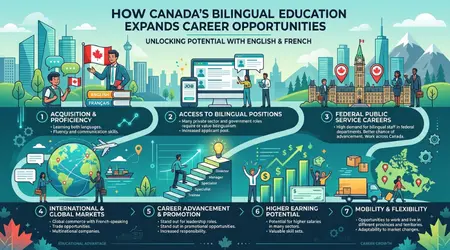
To understand how Canada bilingual education expands earning potential, we have to look directly at the single largest employer in the country: the Federal Public Service.
From my years of tracking Ottawa’s policy shifts and treasury decisions, the administrative architecture of our country is structurally designed around linguistic duality.
If a young graduate aims for an executive path within federal agencies, Crown corporations, or national regulatory bodies, unilingualism is a structural dead end.
The federal system relies on a strict Second Language Evaluation (SLE) framework.
Employees occupying designated bilingual positions must hit specific proficiency levels in reading, writing, and oral interaction (the coveted “CBC” profile) to secure promotions.
Beyond the career progression velocity, there is a direct hit to the wallet. Eligible federal employees who meet these profiles receive an annual $800 bilingualism bonus paid directly out on their paycheques.
While unions have actively lobbied to index this legacy token to modern inflation figures, the real financial reward isn’t the flat bonus; it is the fact that you qualify for the administrative and executive salary brackets ($95,000 to $140,000+) that remain completely invisible to unilingual applicants.
Case Study: A Tale of Two Graduates in the Ontario Job Market
To ground these policy numbers into real-world household math, let us look at a practical scenario involving a middle-class family living in Mississauga, Ontario, with two children who entered the job market over the past couple of years.
The Unilingual Track: Liam’s Journey
Liam graduated with a solid Bachelor of Commerce degree, focusing on corporate finance. He speaks English exclusively.
Upon graduation, Liam applied for entry-level analyst positions across Toronto’s financial district.
Because the unilingual applicant pool was incredibly oversaturated, it took him nine months of searching to land a junior role at a local boutique firm, starting at $55,000 a year.
When his firm look to expand its wealth management services to corporate clients in Montreal and Eastern Ontario, Liam was bypassed for the project lead role because he couldn’t navigate Quebec’s strict regulatory landscape.
The Bilingual Track: Chloé’s Journey
His sister, Chloé, completed the exact same corporate finance program but spent her elementary and high school years in the regional French Immersion stream.
On her resume, she confidently noted her full professional fluency. Chloé secured three interviews before graduation.
She accepted a position with a major national bank’s cross-provincial corporate accounts division, starting at $64,000 an annual salary representing an immediate 16% bilingual premium out of the gate.
Within eighteen months, she was promoted to a regional coordinator role, managing accounts across both Toronto and Gatineau.
| LIAM (Unilingual Track) | CHLOÉ (Bilingual Track) |
| • Time to Hire: 9 Months | • Time to Hire: Before Graduation |
| • Starting Salary: $55,000 | • Starting Salary: $64,000 |
| • Pool Size: 500+ Applicants | • Pool Size: ~45 Applicants |
| • Career Mobility: Provincial Only | • Career Mobility: Interprovincial |
My recommendation for you as a parent is clear: look past the temporary frustration of the grade-school homework table.
The long-term tracking proves that the linguistic investment made during early public schooling translates into shorter unemployment durations and higher starting salary baselines when they eventually leave the nest.
What Are the Real Financial Pros and Cons of Sticking with Bilingual Schooling?
Every major public policy choice involves structural trade-offs, and dual-language streaming is no exception.
As a financial journalist, I believe in looking at both sides of the domestic ledger sheet so you can manage your household expectations rationally.
The Advantages
The primary benefit is long-term economic resilience.
Canada bilingual education expands geographic mobility, allowing a young professional to move seamlessly between major economic hubs like Toronto, Montreal, Ottawa, and Moncton without facing local employment barriers.
Furthermore, the cognitive flexibility gained from early dual-language immersion has been consistently linked to enhanced problem-solving capabilities, a trait that modern corporate AI-driven screening tools highly value in managerial candidates.
The Practical Hurdles
On the flip side, we have to acknowledge the systemic strain within our provincial public school systems. There is a persistent, nationwide shortage of qualified French-language educators outside of Quebec.
This often results in larger class sizes within the immersion streams or longer bus commutes to specialized regional schools.
For parents, it can also mean outsourcing academic help; if you do not speak French yourself, you might find yourself paying for specialized tutors to keep your child’s grades competitive for university admissions.
| System Aspect | The Positive Return | The Family Trade-Off |
| Salary Benchmarks | 5% to 20% lifetime earning premium | Potential cost of private tutoring in early years |
| Geographic Range | Total access to national & interprovincial markets | Longer daily school bus commutes for regional programs |
| Public Sector Access | Unlocks high-tier federal public service salary scales | Navigating strict, regular language reassessments |
| Market Competition | Radically reduces applicant pool sizes for top jobs | Academic pressure to maintain high averages in a second language |
Long-Term Perspectives on Language Education
The nightly struggle over French grammar sheets can test any parent’s patience.
But from where I sit, looking at the hard economic realities facing our younger workforce, that bilingual diploma is one of the most stable, inflation-resistant financial assets you can give your child.
Turn off the translation apps, keep encouraging them through the tough modules, and view those early school choices for what they truly are: a structural down payment on their future financial independence.
Frequently Asked Questions
Does French Immersion actually help if we live in Western Canada?
Yes, absolutely. While it is true that local private businesses in Alberta or British Columbia have low day-to-day bilingual requirements (often under 2%), national corporations, airlines, banking headquarters, and federal agencies operating out west still require bilingual personnel to maintain their national mandates.
A bilingual professional based in Calgary or Vancouver is a rare commodity, making them highly valuable for national accounts.
Is the financial return of core French as high as full French Immersion?
Generally, no. Core French provides basic conversational awareness, but it rarely brings a student to the level of professional fluency required to pass the federal government’s language evaluations or conduct complex corporate business.
If your goal is to unlock the maximum career advantage, moving toward full immersion or extended French pathways is where the true economic dividends sit.
How do Quebec’s evolving language laws affect bilingual job seekers outside the province?
With the recent legislative tightening around corporate communication rules across Quebec, national firms based in Ontario and Western Canada are working hard to ensure their teams can interface legally and effectively with Quebec clients.
This has actually increased the demand for bilingual professionals outside of Quebec, as companies need staff who can bridge the regulatory and cultural gap smoothly.